We’re pleased to announce the release of CorOS 3.2.1 and Cortex Control 1.3.1.
CorOS 3.2.1
Fixed
A crash caused by certain sidechain device configurations.
An issue where Scenes could affect the behavior of Momentary Stomp assignments.
An issue where USB Host playback via ‘Headphones’ briefly dropped when changing Presets.
An issue where FX Loop Level parameters behaved incorrectly between +9.0dB and +60.0dB in the I/O Settings menu.
An issue where ‘CA John’s Amp’ devices produced pop noises when changing Scenes.
An issue that prevented certain User Presets from loading due to resource availability.
An issue where the Directory ‘Sort By’ feature behaved incorrectly.
An issue where the incorrect ‘Author’ name was displayed on the Cortex Cloud app after saving a Factory Preset for a second time.
An issue where information logs could not be sent properly via the ‘SEND REPORT’ feature.
Cortex Control 1.3.1
Fixed
An issue where loading Presets from the ‘Downloads’ folder displayed ‘Save’ instead of the expected ‘Save As’ option. Selecting ‘Save’ in this scenario could cause Quad Cortex to crash.
Fixed an issue where loading Presets from the ‘Downloads’ folder incorrectly displayed ‘Edit Details’, ‘Add to Favorites’, and ‘Delete’ as available options. Selecting these could cause error pop-ups or crashes on Quad Cortex.
An issue that prevented certain User Presets from loading due to resource availability.
This is how we like quick action, fixing bugs reported by us, users.
Update complete, Momentary is now working perfectly. We’re just making a few promises right now, but until then, congratulations on your quick action.
10 days ago, there was a request to fix the popping on John’s amp (I remember Shredd pointing it out). I tried it out (I don’t use that amp, it was more for curiousity’s sake), and sure enough it was there. 3.2.1 is officially downloaded, and it’s gone. Clock it: 10 days for a problem to be rectified. As @nkoala said, the quick action deserves congratulations.
*on an unrelated note, the newest Nano Cortex update includes tap tempo functionality. My main issues when I first got it less than a year ago were: no compressor, no drive block, no tap tempo. Within a couple of updates, my minimal concerns for the unit have been addressed and are now full-fledged features, so the QOL is only improving for that piece of gear in particular as well.
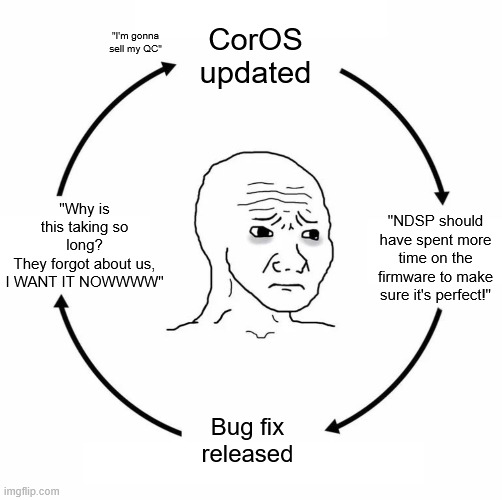
To offer a different perspective, if another update is issued only 10 days after a long-awaited major update, and that second update contains nothing but bug fixes, some might say that the long-awaited major update was very poorly implemented and clearly not tested properly before release… so perhaps getting it right first time (we’d all waited long enough, after all) would be a better way to go about things in future…?
As someone who did work in software development and now works in computer science let me tell you: There is no such thing as a software that is completely free of bugs. It’s plain impossible to test all permutations of parameter assignments in a software that is as complex as today’s software is.
Perhaps it would have been better to release 3.2.0 as a public beta like many other developers do.
The end result would be exactly the same but the beta title implies there may be problems, and invites everyone to find and report them.
Of course. But to have a second update so soon after a big update implies that it wasn’t properly tested (I have no background in software development but I have done Beta testing for another guitar hardware manufacturer)
There’s no way of knowing is this is the case, but ever since I’ve owned the QC, a very common theme on this Forum is how slow Neural are with both updates and also communication with us, their customers.
Rushing to release an update because they feel under pressure, which is what seems to have happened here, would be almost as big a mistake (possibly worse?) as being too slow in the first place - it certainly doesn’t instil you with confidence in Neural’s process and methodology, and I say that as someone whose QC has been with them for a month because it stopped producing any sound (a major bug which is affecting many users on this forum)
@littlespaceman quick anecdote: my company works with a project manager who, once a system is installed (in the realm of a/v integration), starts playing around with the various end points of a system. Very bright fella. He’ll spend a good chunk of time before project handoff muddling in menus and subfolders of the user-facing touchpoints endemic to a system. His superpower, which I’ve witnessed firsthand, is being able to find bugs that were missed by the programmer, or engineer, sometimes even the manufacturer. All just from placing himself in the mindset of a “Joe Schmo.” But it was gleaned the 30+ years in the field. Point being: even the most robust and hell-yeah-it’s-perfect! systems that were ready for commissioning inadvertently have bugs. To quote him, he finds usability faults “playing around like the idiot most people don’t think they actually are.” Dude’s a unit.
Now I’m not calling anyone names here, mind you — but rather just to reinforce the point made by @DavidRSTV: that there is no such thing as bug-free software. It’s a tough tightrope to walk, because I also agree that it can give way to unhappy customers. I guess I’m one of the lucky ones, and hope your unit sees better days if you’ve reached out to Neural about the issue.
I’m thankful for fixes, and even more thankful for a community that talks openly and honestly about the pros and cons of such a (relatively speaking) new entry into the world of DSP. We’ve come a long way from the bean
I wonder what the parameters of beta-testing the QC look like. Are specific instructions given? I’ve never beta-tested anything. No idea how it really works.
But, for example, this recent bug with John’s amps- you would’ve basically had to test changing scenes with every amp model to have caught that. Certainly they’re not testing every setting in every device in every mode in every possible permutation, you just couldn’t really do that I assume.
not sure if a bug or just a change but the “show live tuner in footer” since 1.3.0 in cortex control defaults to being off every session when it used to just keep it on unless i’m missing something
its going to vary depending on the device but I know that when I was a beta tester for the now discontinued pearl mimic module it was a matter of asking all beta testers to test all general functionality. Changes, look for bugs. Using sliders and things to make sure no bugs in the touchscreen U/I. We all had different kits so many of us were asked to make factory trigger presets for certain pads which was a very pointless task. Even if we didnt normally use it we were asked to see if it changed from the previous version in any negative way.
The speed of updates was highly reflective of the creative vision of the single head person in charge of developing the unit. He was not a drummer but rather a programmer and guitarist. He was tasked with porting the steven slate drum VST into the pearl mimic module and expanding features as time went on and much like adding PCOM the promise was that it was always going to have conversion software that could duplicate and make round robin samples of ANY drum VST out there and so you could import a fully converted pre processed drum kit from superior drummer 3 and load it directly into the module. This eventually did happen but the company who owned it decided to focus on another full electronic drum kit that required proprietary hardware and it failed to deliver on its promise.
The mimic did end up being 95-98% of what was publicly promised and talked about in various groups. But the constant backlash of not being able to please everyone took a toll on development. The main guy didnt know what direction to take the module and we asked for a lot of things that at first would not have but we kept pushing. The slogan was toted as the most powerful drum module in the world. Which many requests were deemed too difficult. This was a $2200 VST module msrp but usually sold around $1800 on sale. But still thats roland money. But this thing is sounds and feels like real drums because its samples of real drums and you control the dynamics. Very sophisticated for what usually are one shot samples. Anyways.
Thats how that situation went. I had left the group frustrated because we had a year of no updates. And that was even for us beta tester who couldnt publicly talk about anything. We couldnt even tell people we were on the team at the time. It started as me and three other people and expanded to 12. And it was clear to me that either there was no solid direction and plan from the start and the court of popular opinion was always going to overrule any logic or rational thinking. At least then did an update and actually used the onboard eq to make the drum kits processed and sound good without tweaking. That showed people what it could do. But even then. People with no experience would complain and say it didnt sound good but it was because they didnt know how to mix drums and eq them to get different sounds. Even AFTER looking at how the kits were made.
I cant speak for neurals team. How big it is. Or if they have different departments coordinating together or if its one team trying to do all the things at once. But did I expect them to correct those issues in 10 days? Hell no. So I applaud that quick correction. Should it have happened? I dont think any of us know enough about the quads circuitry, board revisions, internal design changes and now a codec change in conjunction to know how that could have an effect on foolproofing any beta test. I know that with us, there was always at least one bug that almost everyone one missed but one or two of us would catch it. And people still reported issues. But not having the same gear we couldnt replicate some of the issues that seemed to be specific to certain hardware.
Interesting story, and a great description to my mind of a good way to find bugs - in the words of a friend who is a Clinical Psychologist (and therefore knows a lot about human behaviour), “The one thing I’ve learned in 30 years of being a Clinical Psychologist is you cannot predict human behaviour”. Or in other words, someone will find a way to find that gap or flaw in any system, usually unintentionally!
My background is in commercial aviation, so I perhaps have a pretty short fuse when it comes to poorly implemented UI’s or buggy updates (commercial jets do have software updates, especially in their navigation and performance databases, and as you can imagine the testing process to be able to release those updates is extremely robust)
With the hardware I was given there was some direction, but it was basically a case of ‘play a ound with it as much as you can and let us know if you come across anything weird’
very interesting. I considered the Mimic when I first heard about it, I’ve used the Slate software in the past. Always wondered what happened there, as it never quite seemed to hit the market like I expected it might
well. The biggest thing was that people were upset that for many like me who just wante to make drum sounds that sounded post processed Its killer. And be able to sculpt your own tone. But the mimic was a huge departure from all drum modules at that point. Its biggest competition was Roland. The TD30 and TD50. Both great modules with infinite amounts of sounds and innovative pad and trigger designs but as far as realism it was all digital manufactured sounds. Machnine gunning was an issue on even the best rolands. But yeah I think the mimic really fizzled out because they invested too much money in a different complete kit like a roland that was very limited in sounds and awkward. I think it was called the Emerge. I predicted it was going to be a lead balloon and yeah I think only hardcore Edrum guys would even remember that thing. It came and went before you knew it was released.
I updated a few days ago but was only able to play around a bit today. Just want to say thank you and well done to the Neural team - this is an outstanding update! I love the changes and new feature additions, and the overall look and feel.
Plus, for reasons that are not clear to me, I no longer need to use a mobile hotspot to run updates. It is likely related to the new router I set up, and I can now say for sure that the wifi receiver in the QC was unfairly suspected, for quite a while now!