TL;DR I did an experiment to figure this out some time ago. Since I’m sitting here on standby, what better use of my time than to share the findings! If you read the full breakdown below, this will make much more sense but the synopsis is: the QC’s capture of the reference amps showed observable differences when compared to the Kemper Profiler Stage Mk.II. These differences were sonically and visually observed, using a DAW and spectrum analysis plugin. Using 3 reference amplifiers (clean, dirty, high-gain), the QC presented more midrange frequencies in its captures, specifically within the 400-500Hz range, across both the clean and dirty reference amps. For the high-gain reference, the QC presented this similar bump but extended further in the range of 400kHz-1kHz. Since the QC reproduces more of the midrange found in the references than the Kemper, and in consideration of the human ear’s natural proclivity to responding positively to midrange frequencies at appropriate SPLs, the QC offers a more sonically accurate experience than the Kemper option and as such can be perceived as generally more pleasing to the human ear.
It is worth mentioning that the experiment conducted, which I detail below, could be recreated in the same environment to produce the same results. All hail the scientific method.
____
If you got this far and are still reading, well, thanks! Grab a cup of coffee and settle in. Since I’m sitting here waiting and enjoyed your question, I imagine my conclusions may be of interest. The conclusions were gathered from one of the many “nerd nights” my friends and I often get into with gear. In this case, it was A/B-ing my Quad Cortex with his at-the-time newly purchased Kemper Profiler Stage Mk.II. You know, I feel rather lucky that my friend group is so heavily invested in music, because gear talk and gear swapping has been our world since we met in our late teens, and there’s always a piece of someone else’s rig living at another person’s place. We’ve all run a gamut of sorts between analog and digital setups, but between the guitarists, the major bases have been covered in terms of modelling. We grew up on combos and gigging, so we know the amps and pedals we like. And I’ve talked about it on this forum before, but my physical need for an amplifier and pedalboard pretty well ended with the QC. Prior to that decision, I’ve put in my time with Fractal, Line 6, and plugins as well, so I’m at least informed on the capabilities of modelling gear in this guitar-centric space (but always still learning)! Now, for your question: “What is it that just makes it so pleasing in response and to the ear?” When my buddy got his Kemper, we had to put the new gear through its paces: this means busting out the manual and bringing out some amps to reference! We’d play some presets on each others’ unit, then make some captures/profiles of the referenced amps, then compare to our hearts’ content. We A/B’d not just with our ears, but also with a spectrum analyzer (Voxengo SPAN) for the visual representation of what we were hearing. I ran the DAW side of things, using Logic specifically. Opinions can’t be measured, but frequencies can — so with the tools and gear ready, we’d be able to objectively pinpoint specific frequencies and ranges that would come up in a comparison (and Voxengo is great for this because it has integrated LU/LUFS metering right in the plugin; it certainly helps with matching track levels quicker, I found). Keep in mind that the purpose of the nerd night was purely observational and exploratory, and not to see which option between these two pieces of gear was the ‘winner’ so to speak — since technically, we’d already made that decision with our wallets. So, with that context out of the way, here’s what was observed in our capture and profile comparisons. I’ll start with some specs:
- For reference amps, we used three: a 2010 Fender ‘65 Deluxe Reissue for cleans, a 2009 Budda Superdrive 18 Series II combo for dirt, and a 1992 5150 block-letter for the high-gain, aided by a TwoNotes Torpedo. With the references captured, a short riff passage that incorporated single-notes and full chords was then recorded into Logic as a dry signal. The instrument used to record this dry signal was an Aristides 060R with Seymour Duncan Nazgûl/Sentient pickups. This dry take would then be re-amped with the captures and profiles, and we’d find out the sonic differences in real time, along with the visual representation of the EQ curves
After all the dirty work had been done, the listening portion began and the differences between my QC and his Kemper were indeed distinguishable:
-
The prime difference was a more pronounced midrange observed in the QC captures of the Fender and the Budda, in the 400Hz-500Hz range. The 5150 was bumped up as well on the QC captures, but from 400Hz up to 1kHz. Treble and bass variances were existent, but the deltas were not significant enough to note, with the justification being that in a live environment/jam/studio session, these variances would be indistinguishable when additional instrumentation had been incorporated
-
It’s important to note as well that the stock 5150 III Red/Blue options on the QC were more dialled in for our tastes than what we achieved with the 5150 reference (and yes, I am aware that they are different amps altogether — but fundamentally from the same series, so a similar sonic character was observed). Of further note, Kemper has a profile of a 5150 with a baked-in Tube Screamer in front of it (“Pea V 150 TS9”), and it sounded near identical to our 5150 but with ≈3.0dB of added gain and an uptick in the 2kHz range. Adjusting the 5150’s lead channel post gain knob clockwise reproduced this ‘uptick’ in near-identical fashion.
Here’s what we walked away with: first off, make no mistake — both pieces of gear sounded fantastic, and Kemper makes phenomenal equipment. Full stop. However, that night lives on in my head, because the QC just sounded better to me, so I asked the same question you did essentially. From the A/B-ing between everything, I posit the claim that the QC “sounds better” because it was capturing the midrange more effectively, and when we listen to and/or play through these captures at appropriate SPL levels, we are hearing more of the reference’s nuances that we otherwise would miss if the gain settings were pushed to drive the amp to that point of ideal saturation (this point, though, sometimes comes at the cost of crossing the threshold of pain for human hearing — especially in the case of the 5150).
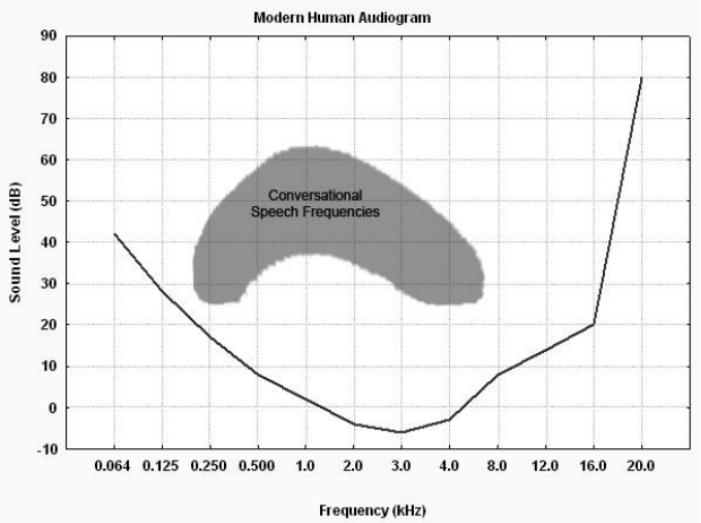
With a more apparent midrange, we’re hearing more of the captured amp’s character in the QC’s case. And since the human ear is naturally and primarily tuned to hearing midrange frequencies associated with human speech, you’ll see how some of the frequencies line up with our nerd night conclusions. See the chart below: it is an excerpt from the ‘The Psychology of Language’ that showcases the human audiogram; the solid line is the minimum audible threshold as a function of frequency (the minimum sound level at a given frequency which a human subject can correctly perceive at least 50% of the time). Note the shaded grey area for frequency/SPL levels that correspond to conversational human speech. I. Martínez, Professor of Human Evolution, Alcalá University, October 2012).
Therefore, with the presence of that extra midrange in the QC captures in comparison to the Kemper profiles, the logical conclusion is that at an appropriate SPL level, the QC offers a more pleasing listening/playing experience because it is sonically producing more of what our ears are naturally tuned to hear. Voila.
A few caveats: to avoid confirmation bias here, let me address something I’m sure we know but bears stating regardless: there is considerable variation between what frequencies people can hear and how they are perceived. Every ear is different, which is why the human hearing range is averaged as a common band of 20Hz-20kHz. So, clearly, subjectivity comes into play when we discuss how sound is ultimately interpreted. Things like hearing loss, directionality, digital amp model capture quality, hell even the age of the player’s ears… these are just a sampling of the small idiosyncrasies that can wildly impact the final interpretation of any sound. So I do take that into account. Just because it sounds good to me didn’t mean the Kemper was bad, and as my friend stated, he’d take sound of the Kemper with the “everything else” about the QC. His preference was different, therefore he is correct in what he sees as ‘the best option for him.’ I’m happy he found a piece of gear that’s inspiring.
It’s also why I find it odd that some people choose to bash others’ gear for how it “sounds.” In that event, those people that dole out such comments are likely doing more for informing others about their character as opposed to contributing to the discussion on their own subjective sonic preferences. But that’s another topic for another time. Forums are for learning and sharing, and I even learned some stuff about comb filtering recently through here, so it’s a great exchange of information. I hope what I brought to the table offers some insight, and I’d love to hear what anyone who made it through thinks (especially you, @Drjoeljr!). Thanks for reading.
 and i hate this behaviour, finding another plugins of other specific brand more authentic and Natural on this aspect